

Sticking between Evergreen Fog SW 9130 and Dried Thyme SW 6186, is common.
These two Sherwin-Williams greens have taken over the paint world and for a reason.
Both are muted, earthy, and have an organic vibe, but they’re not the same and they look interchangeable.
The evergreen fog vs dried thyme confusion is real, and picking the wrong one can make your room cramped.
I’ve worked with both colors more times.
They show up in modern homes, transitional spaces, and anywhere those who want the nature-inspired feel without going whole forest green.
They both live in the green-gray territory, but they behave differently when they’re on the walls.
Homeowners keep getting confused because they look a bit similar on the small paint swatches.
Choosing the wrong undertone isn’t only annoying but it can make your space feel either too cold or too heavy.
Here, I’m breaking down about Evergreen Fog Vs Dried Thyme, like the personality of each color, their LRV, how lighting changes them, undertone differences, and which rooms they work in.
I’m also putting comparisons with other popular greens.
Here are my other blogs that you can also read:
- Quiet Moments Vs Sea Salt
- Tricorn Black Vs Black Magic
- Liveable Green Vs Softened Green
- Light French Gray Vs Agreeable Gray
- Peppercorn Vs Iron Ore
Sherwin Williams Evergreen Fog Color Overview (SW 9130)
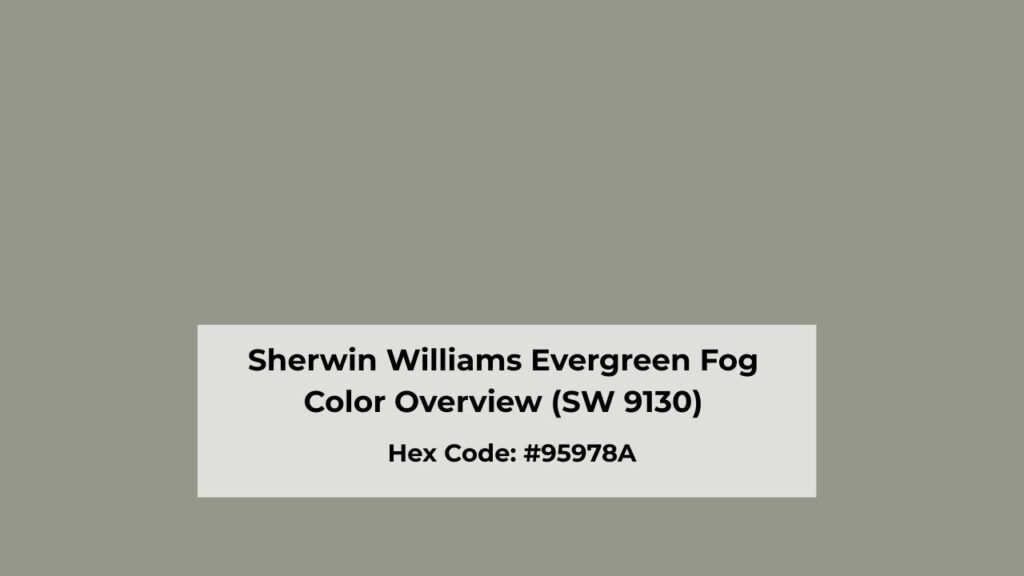
Evergreen Fog is the soft green-gray everyone considered when Sherwin-Williams named it their 2022 Color of the Year.
It’s light, muted, and has a modern-calm thing going on that works in contemporary spaces.
The LRV is 30, which means it reflects a decent amount of light.
What makes it tricky is the subtle blue undertones.
Sometimes it looks more gray than green, mainly in rooms with low light or north-facing windows.
I’ve seen it lose its green in a basement bathroom and it looked like a cool gray.
But in the good natural light, the soft green comes and it looks beautiful.
The saturation is low, giving it a hazy and ethereal look.
It doesn’t look so GREEN, but it whispers it.
That’s why it fits well in modern, transitional, and Scandinavian-inspired interiors.
I’ve used it in living rooms where clients wanted color but were terrified of commitment.
Bedrooms where they needed calm. Kitchens on cabinets when white felt too boring.
Bathrooms with this color turn out nice, especially with white tile and matte black fixtures.
The airy quality keeps the space from feeling closed in, which is major in small bathrooms.
Sherwin Williams Dried Thyme Color Overview (SW 6186)
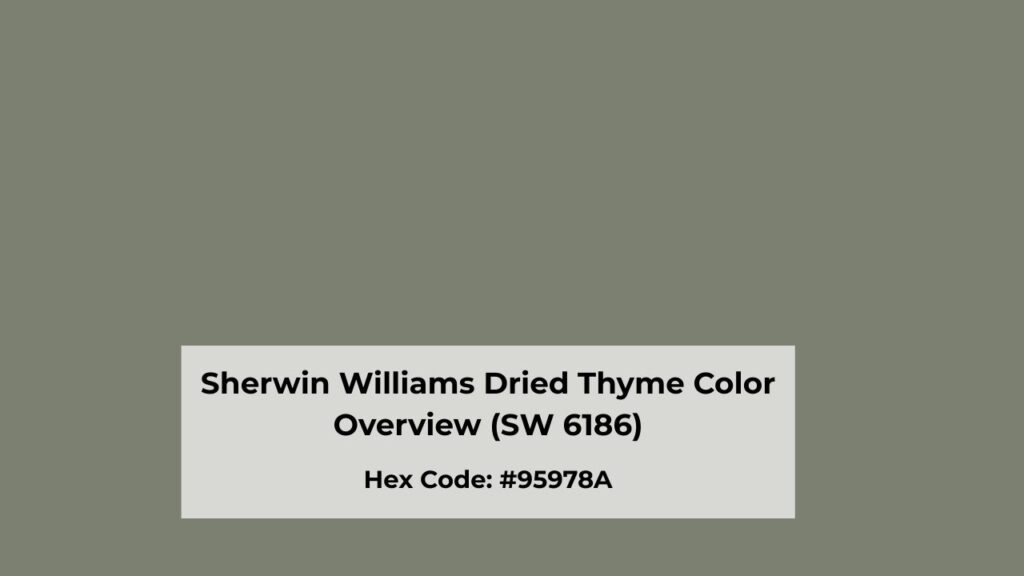
Now, Dried Thyme is a different thing.
This is a deep, earthy green with strong brown undertones which makes it feel grounded and cozy.
And it is darker and richer than Evergreen Fog.
The LRV is at 21, so it absorbs light and looks heavy on walls.
The saturation is high and it’s more present.
You know it’s green, but it has an olive-brown thing that can look gorgeous or wrong depending on your lighting.
I learned this the hard way on a dining room project where the homeowner had warm Edison bulbs.
The color pulled brown and it looked muddy.
What I love about Dried Thyme is how it holds its color across different lighting.
It shifts warm or cool, but it doesn’t flip personalities like some chameleon.
It stays like itself, like a moody, dramatic, nature-inspired character.
It has traditional and rustic vibes built, but I’ve also seen it work well in modern spaces when paired with the right materials, like warm wood tones, aged brass hardware, natural stone.
It ranked 4th in Sherwin-Williams’ most popular greens, and it’s in Samplize’s Top 40 best-sellers, which tells you people are using it
I recommend it for dining rooms, home offices, accent walls, and cabinetry.
Full rooms need good lighting or they can feel cave-like. And powder rooms look perfect.
Evergreen Fog Vs Dried Thyme: Key Differences
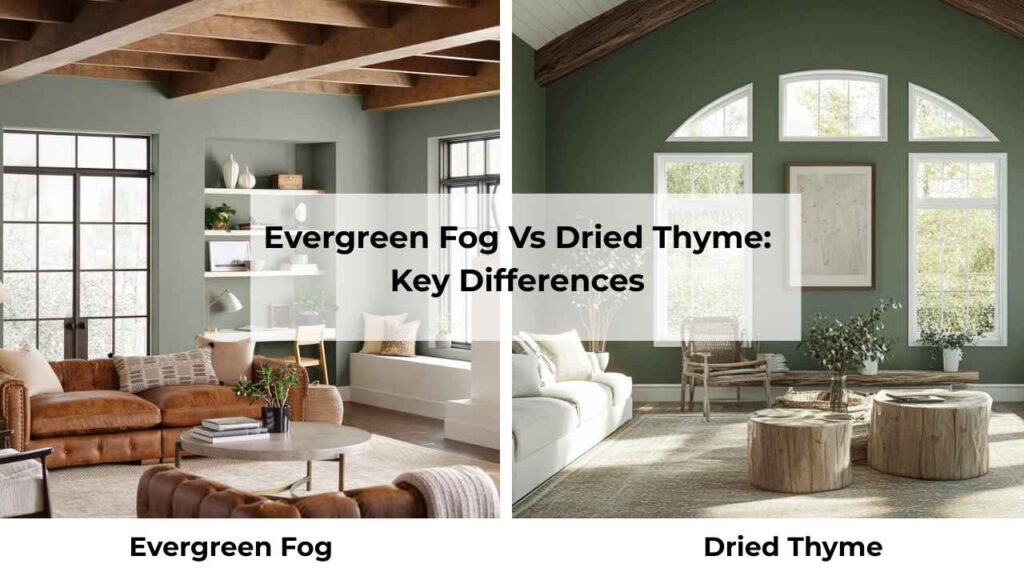
Evergreen Fog Vs Dried Thyme, get compared almost every time, but they have different purposes. One’s light and flexible, the other’s bold and moody.
Let me break down what matters when you’re choosing between them.
LRV
Light Reflectance Value is how much light a color reflects on a scale from 0 (black) to 100 (white).
Evergreen Fog is at 30 and this comes in the medium territory.
It brightens spaces without being pale.
You can use it in medium-sized rooms without worrying it’ll make things feel cramped.
Dried Thyme is at 21 which is dark.
It absorbs more light and makes walls feel close.
This isn’t bad if you want cozy, but in a small room with limited windows? It can get heavy fast.
I’ve seen it work well in large spaces with high ceilings where the depth feels intentional instead of suffocating.
The 9-point difference looks small but it’s visible.
Undertones
Evergreen Fog has green as the primary undertone with gray, with the subtle blue undertones.
Sometimes you see a hint of warmth too, but it is cool.
In north-facing light, the blue comes forward and it feels cold. In the south-facing rooms, it brings the green and balances things.
Dried Thyme has green too, but it’s layered with brown, gray, and olive undertones which gives it warmth and earthy vibe.
Also, warm lighting pulls the brown in the highlight.
Cool lighting emphasizes the gray.
It’s not a true warm or cool green, it is in the middle.
I always tell people to test both in their space because undertones shift a lot depending on what light is there and what time of day you’re looking.
Lighting Impact
Evergreen Fog in different rooms:
North-facing spaces push it grayer and cooler.
It loses some personality but can work if you want something subtle.
South-facing rooms are where it shines, the green comes alive without getting intense.
East-facing rooms get the fresh, airy feel in morning light.
West-facing rooms warm it up in the afternoon but it stays balanced.
Dried Thyme in different rooms:
North light makes it deep and sometimes flat.
South light brings out the richness and balances the brown and green.
East-facing rooms keep it cool in the morning, which I prefer.
In the west-facing rooms, the afternoon light can make it brown.
Understanding how light affects these colors is non-negotiable.
Buy the peel-and-stick samples and watch them the whole day.
Morning, noon, evening, night with your lamps on because that is the only way to know what you’re getting.
Style and Best Uses
Evergreen Fog works best when you want modern, minimalist, or Scandinavian aesthetics.
You can pair it with soft warm whites on trim but not too bright.
Alabaster or a creamy white keeps it from feeling cold.
For furniture, light wood tones, white oak, pale stone, matte black accents.
Dried Thyme loves traditional, rustic, and earthy styles.
Pair it with cream-based whites or soft off-whites on trim.
Bright white looks too sharp against it.
Furniture-wise, go for medium to dark wood, walnut, bronze hardware, terracotta accents, because it wants warmth around it.
| Aspect | Evergreen Fog | Dried Thyme |
| LRV | 30 | 21 |
| Depth | Medium | Medium-dark |
| Mood | Airy, calm, modern | Cozy, moody, grounded |
| Undertones | Green + gray + subtle blue | Green + brown + gray |
| Flexibility | High – works whole-home | Moderate – best for specific spaces |
| Lighting Sensitivity | Moderate | High |
| Best Trim | Soft warm whites | Cream-based whites |
| Style | Modern, transitional, Scandinavian | Traditional, rustic, nature-inspired |
How Do Evergreen Fog and Dried Thyme Look in Different Rooms?
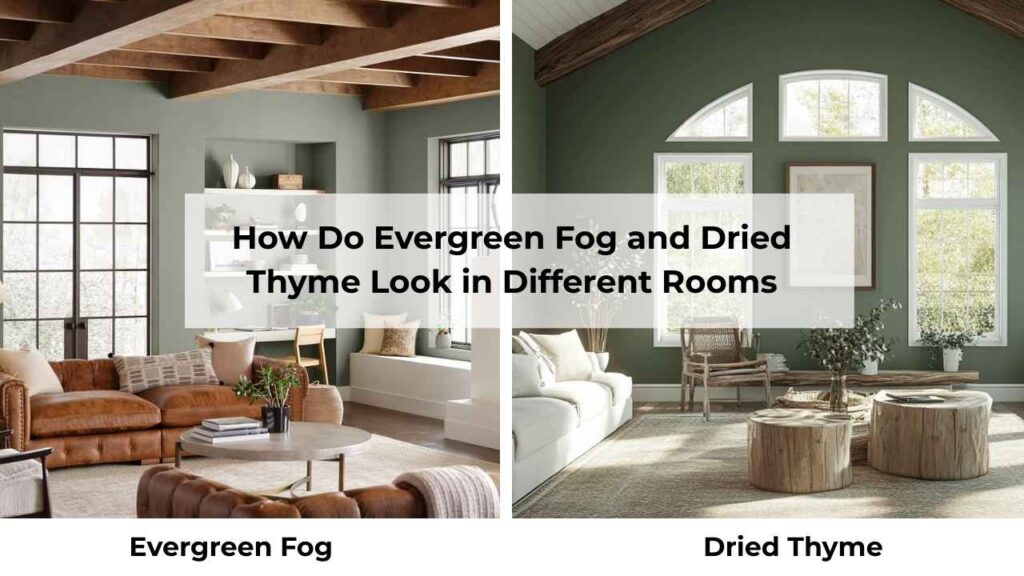
Okay, let’s get practical.
Where do these colors work nicely and how do they make an impact on these rooms.
Living Room

Evergreen Fog in a living room creates a calm, grounded backdrop that doesn’t go against your furniture.
It’s present without being demanding.
I’ve used it in open-concept spaces where the living room flows into the kitchen and it ties everything together without making the space feel stuffed.
It pairs well with beige sofas, greige accent chairs, blush pillows.
The softness lets you layer different textures and colors without things getting loud.
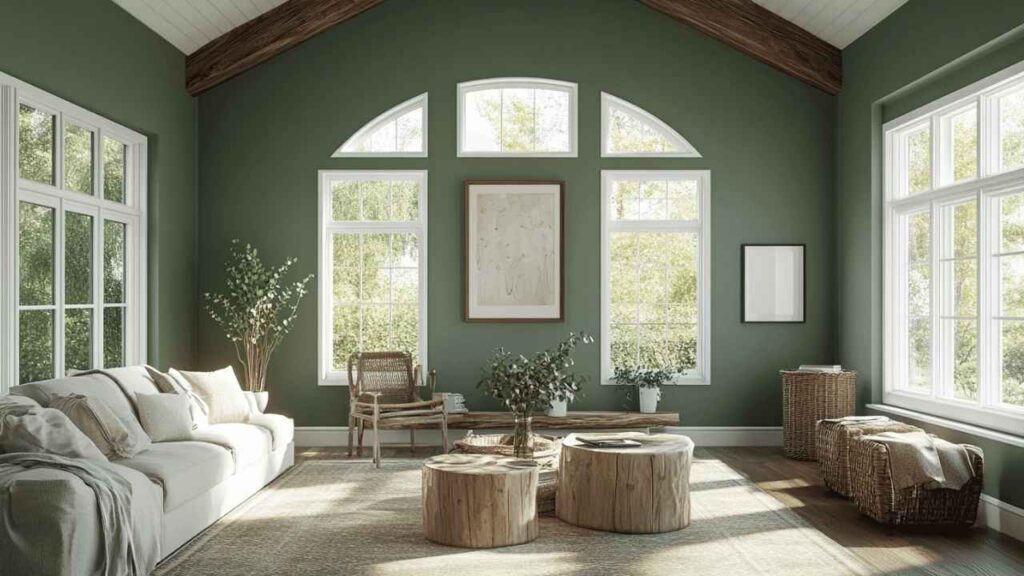
Dried Thyme in the living room makes a statement.
It adds drama and coziness but you need natural light to keep it from feeling closed.
I’d use this in living rooms with good-sized windows or high ceilings.
It looks nice with leather furniture, warm wood coffee tables, and vintage or traditional decor.
Bedroom

Evergreen Fog is my favorite choice for bedrooms.
The muted, calming quality works in a sleep space and it’s not stimulating nor boring.
I’ve done it with white bedding and natural wood furniture and it creates a serene, spa-like vibe without feeling out of place.
North-facing bedrooms may make it cool.
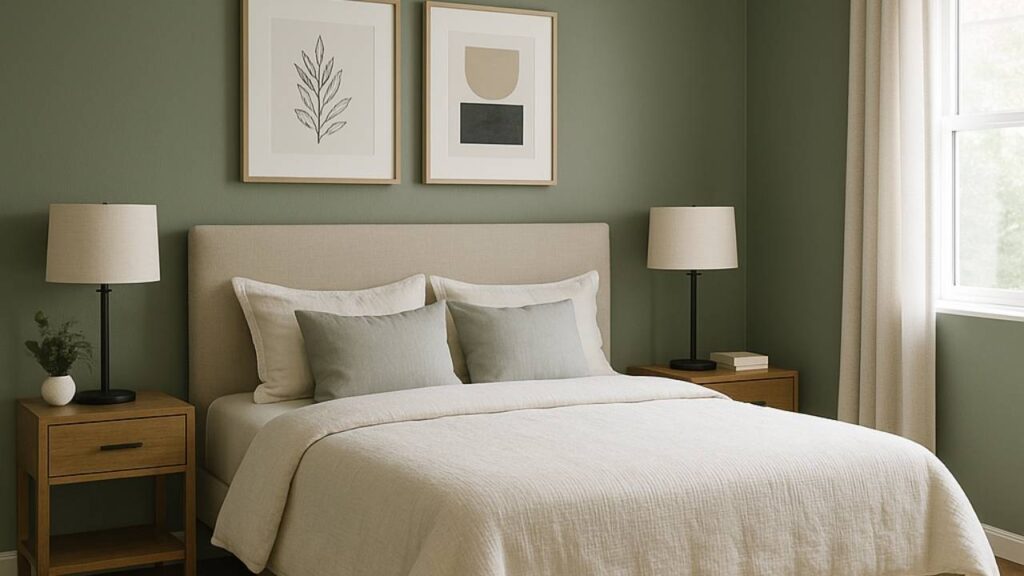
Dried thyme in a bedroom can be cozy and cocoon-like.
Some people love the moody, enveloping feel.
I don’t love it for bedrooms because the dark LRV can make mornings feel heavy.
If you’re someone who sleeps with blackout curtains and doesn’t care about bright and airy, then you can consider this paint color.
Pair it with cream bedding and warm lighting.
Bathroom

Evergreen Fog in bathrooms with good lighting is good.
It keeps the space feeling fresh and open, mainly with white tile, marble, or light stone.
Matte black fixtures or brushed brass both look great against it.
I’ve done it in a small powder room with one window and it feels airy.
But make sure you have light, whether it is natural or artificial.

Dried Thyme in a bathroom needs to be a powder room or a bathroom with excellent lighting and ventilation.
The deep tone can feel spa-like and luxe if you have stone, warm wood vanity, and good fixtures.
But in a cramped bathroom with one small window, it’ll feel dark and small.
Kitchen
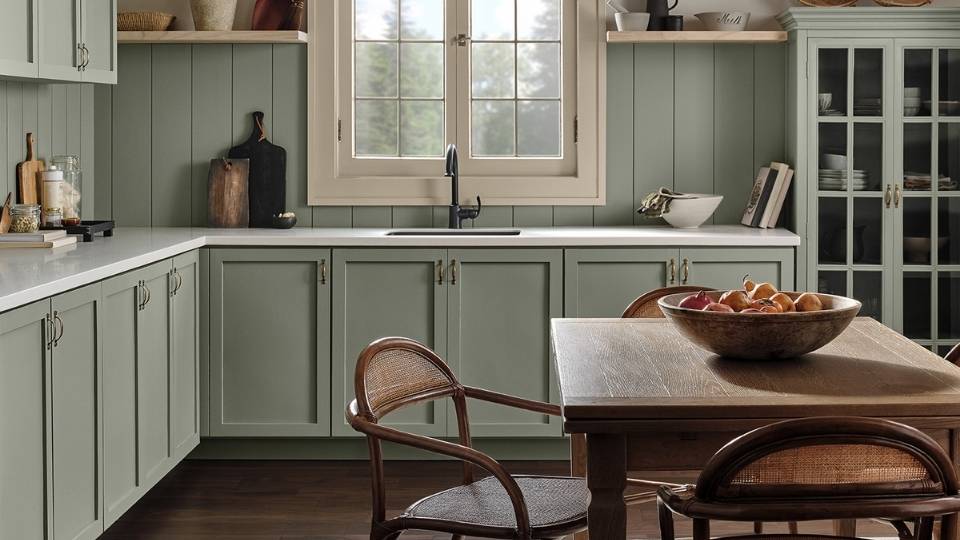
Evergreen Fog on kitchen cabinets has become popular, and I get why.
The medium LRV adds character without making the kitchen feel heavy.
It works on islands, lowers, or full cabinetry.
Pair it with white uppers if you’re doing lowers, or go in if you have light and white countertops to balance it.
Light wood floors, pale stone backsplash, brass or matte black hardware, makes it great.
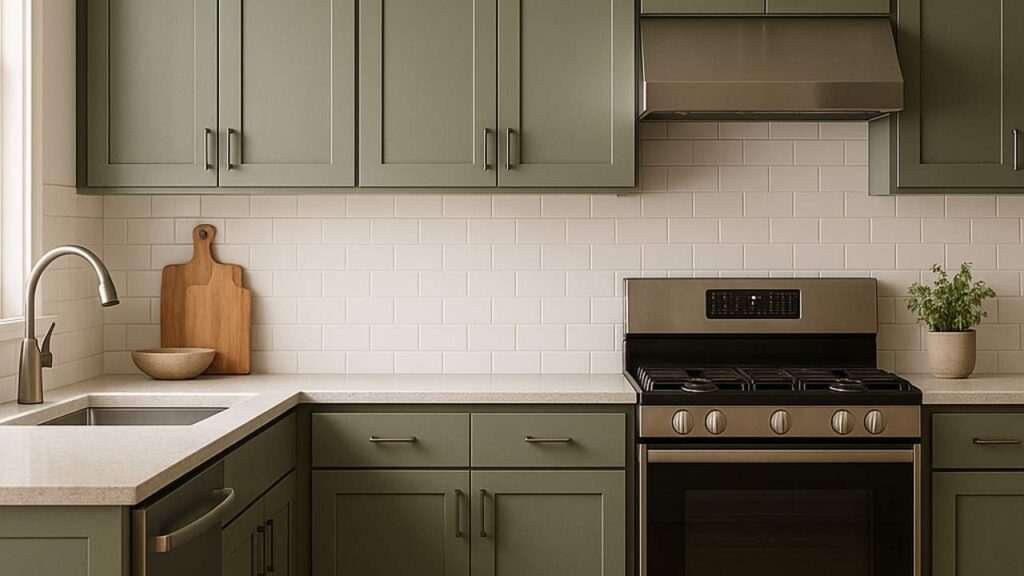
Dried Thyme on kitchen cabinets is bold.
I’ve done it on islands and it looks rich, mainly with butcher block countertops or white quartz.
Full kitchen in Dried Thyme, you need a big kitchen with light and white or light uppers to break it up.
But when it works, it works well.
Exterior

Evergreen Fog on exteriors gives you a modern, fresh look without being bold.
It works on siding, front doors, shutters.
It photographs beautifully and has this sophisticated, understated vibe.
Pair it with white trim and a natural wood or black front door.

Dried Thyme on exteriors creates a grounded, organic look that feels like it belongs in the landscape.
It’s less common than Evergreen Fog for full exteriors, which makes it feel unique.
I’ve seen it on craftsman-style homes and modern farmhouses and it fits.
White or cream trim is a must.
It can look brown on exteriors depending on the light, so sample it.
Evergreen Fog Vs Dried Thyme Vs Other Colors
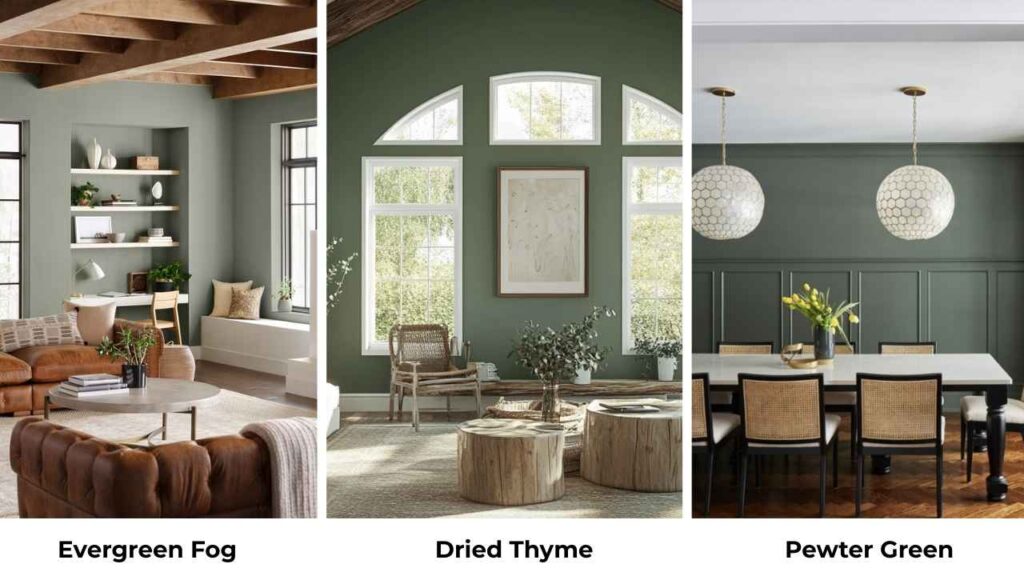
Chances are you’re not only comparing these two but you’re looking at other greens and losing your mind. Let me help.
Pewter Green Vs Dried Thyme
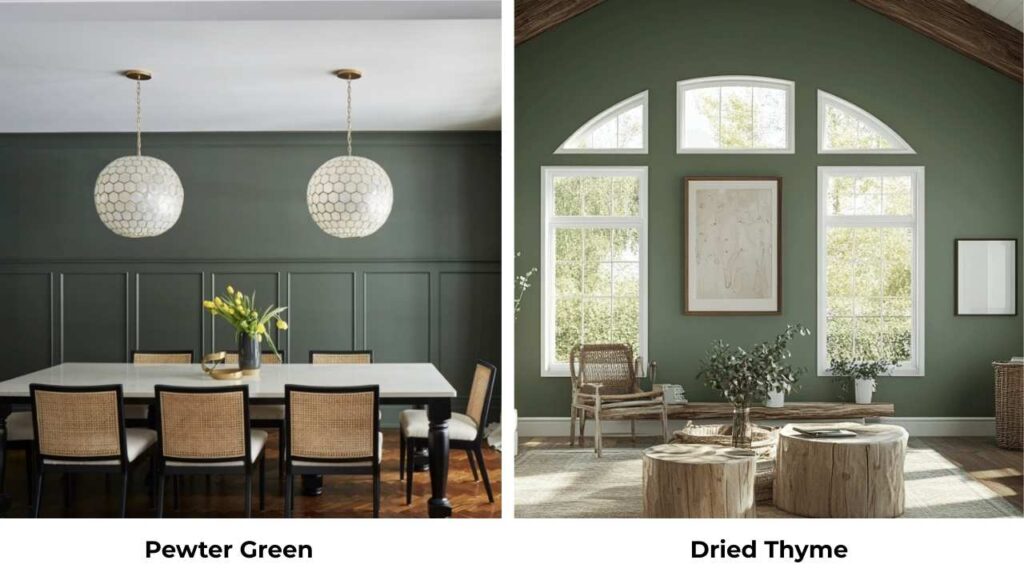
Pewter Green (SW 6208) is darker than Dried Thyme with more gray influence.
It’s moody and cooler-toned.
If Dried Thyme feels too brown for you, Pewter Green may have the spot.
But it’s also dark because it has a lower LRV so it needs more light.
Sherwin Williams Dried Thyme Vs Rosemary
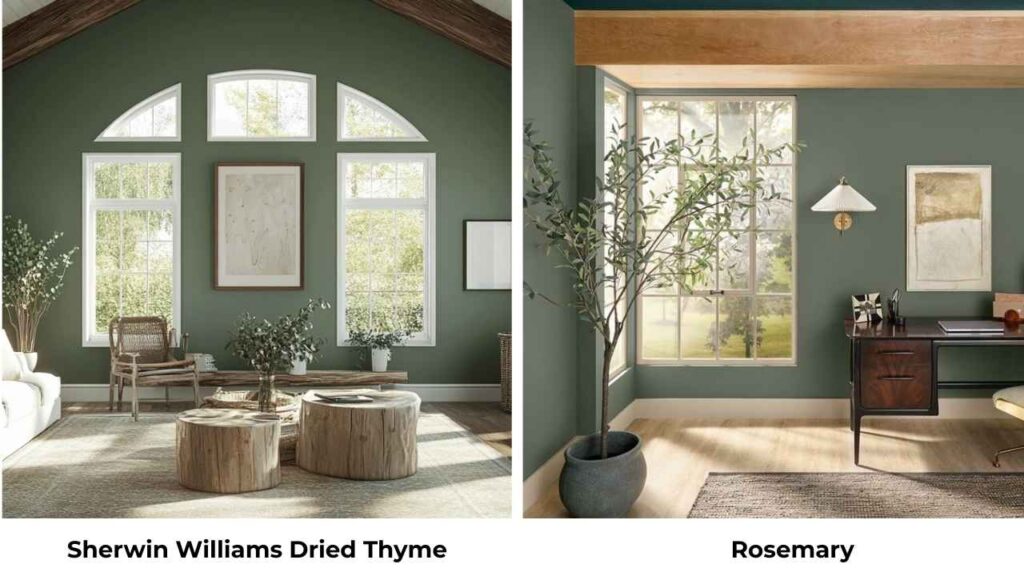
Rosemary (SW 6187) is deeper and more saturated than Dried Thyme.
It has an LRV of 14 versus 21.
It’s for when you want drama and depth. Side by side, Dried Thyme looks light and wearable.
Rosemary is a commitment.
SW Dried Thyme Vs Retreat

Retreat (SW 6207) is cooler-toned than Dried Thyme with more blue-green influence and less brown.
If Dried Thyme is pulling too warm and olive for your space, Retreat gives you the cool, teal-ish green.
It has similar depth but a different personality.
Evergreen Fog Vs Rosemary
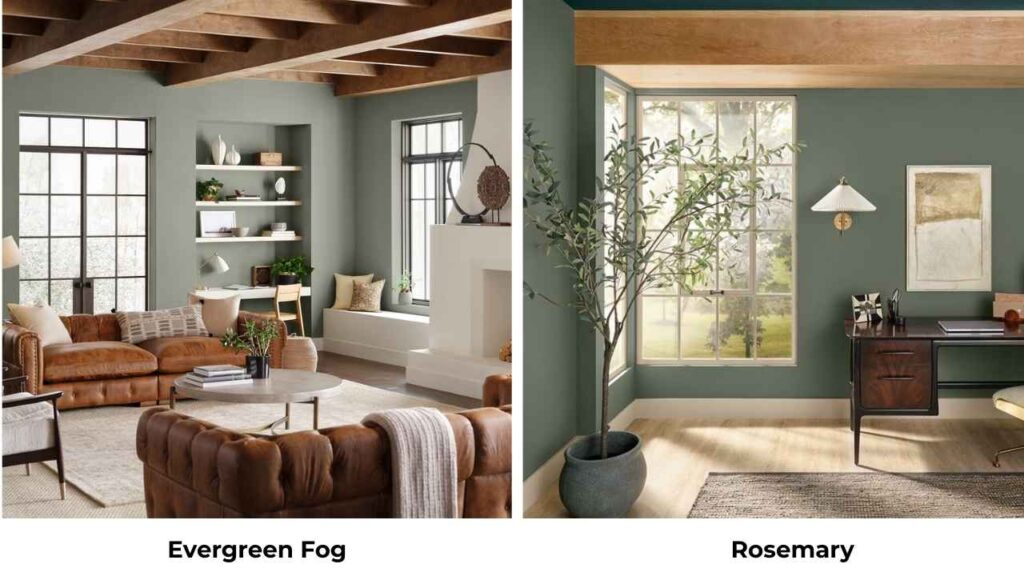
These two aren’t even in the same category.
Evergreen Fog is light and soft (LRV 30), Rosemary is dark and rich (LRV 14).
If you’re deciding between these, you need to figure out if you want light and airy or bold and moody.
| Comparison | Key Difference | Choose If |
| Pewter Green vs Dried Thyme | Pewter Green is darker, grayer, cooler | You want moodier, less brown |
| Dried Thyme vs Rosemary | Rosemary is much deeper and more saturated | You want maximum drama |
| Dried Thyme vs Retreat | Retreat is cooler with blue-green undertones | You want cooler-toned green |
| Evergreen Fog vs Rosemary | Complete LRV opposites (30 vs 14) | You know if you want light or dark |
Sherwin Williams Dried Thyme Color Palette
If you’re going with Dried Thyme, surround it with the right colors so it doesn’t look muddy or isolated.
SW Alabaster or BM White Dove for trim, both are soft warm whites that won’t go against the brown undertones.
Accessible Beige or warm taupes for adjacent walls if you’re not doing the whole room.
Deep browns or walnut tones in furniture. Terracotta or rust as accent colors.
Aged brass, bronze, or black matte hardware and fixtures.
Cream or natural linen textiles.
Basically, keep things warm and earthy around Dried Thyme.
Cool grays or bright whites will fight with it and create an uncomfortable vibe in the space.
Sherwin Williams Evergreen Fog Color Palette
Evergreen Fog plays better with a range of colors because of its softness and flexibility.
Pure White or Alabaster for trim both work great like Pure White if you want clean and balanced, Alabaster if you want a touch of warmth.
Agreeable Gray or soft greiges for adjacent spaces.
Light oak or white oak wood tones. Matte black, brushed brass, or even chrome fixtures.
Soft blush, muted terracotta, or pale blues as accent colors.
Creamy whites and light linens in textiles.
The key is keeping things light to medium in tone so the Evergreen Fog stays soft and doesn’t get weighed down.
Conclusion
Look, choosing between Evergreen Fog Vs Dried Thyme is a bit confusing and tough too because both colors are beautiful and they’re popular for a reason.
Evergreen Fog is safe, flexible, whole-home green which adapts to different spaces and lighting.
It’s modern, calm, and easy to work with.
Dried Thyme is your bold, moody, statement green which works best when used in well-lit spaces or as an accent.
Pick Evergreen Fog if you want something light and forgiving.
Pick Dried Thyme if you want depth and can consider dark colors.
But remember to test them both in your space with your lighting before you commit.
Use the peel-and-stick samples for the better choice.
Picking between Evergreen Fog vs Dried Thyme is like the opposite because one is light and airy and the other one is cozy and grounded.
So, go according to your space like which one will look nice in your space.
FAQs on Evergreen Fog Vs Dried Thyme
BM October Mist is light and warm but in the same sage-green family. SW Clary Sage has more yellow undertones and is brighter. SW Escape Gray is similar in coolness but is lighter (LRV 41).
LRV is the big difference, Evergreen Fog is 30 (medium-light) and Dried Thyme is 21 (medium-dark). Evergreen Fog has gray and blue undertones and looks cooler. Dried Thyme has brown and olive undertones and looks warmer. Evergreen Fog is flexible and modern, Dried Thyme is moody and traditional.
No, not for most spaces. With an LRV of 30, it’s balanced. It can look dark in north-facing rooms with limited light, but in most average-sized rooms with decent natural light, it feels soft and approachable, not heavy.
Dried Thyme has green as the primary undertone with brown, gray, and olive undertones layered underneath. The brown can come forward in warm lighting, making it look earthy and almost muddy if your lighting is warm.
Evergreen Fog Vs Dried Thyme: Choosing the Right Green for Your Home