

Over the years, I have worked on everything related to interior design – from small patio updates to full home renovations.
Concrete has always played a quiet but a critical role in these renovations.
But when selecting between the best concrete mix, the choice often comes down to sakrete vs quikrete, especially when strength, finish, and long-term performance matter.
Wrong choice or incorrect concrete mix can seriously impact the durability, surface quality and timelines of your property.
Both Sakrete and quikrete are trusted concrete mixes but they are designed with slightly different purposes in mind.
When my clients ask me about sakrete vs quikrete, I explain that Sakrete is often chosen for fence posts and basic slabs, while Quikrete is widely used for repairs, footings, and structural work that needs consistency.
In this sakrete vs quikrete comparison guide, I will be breaking down everything based on composition, common uses, workability, and real site performance.
You will learn where each mix performs best, what to consider before buying it, the differences between the variants, and we will also dive into their pros and cons.
My goal is simple – it’s to help you choose the correct product for your project and confidence.
Sakrete Concrete Explained: Uses, Strength, and Performance
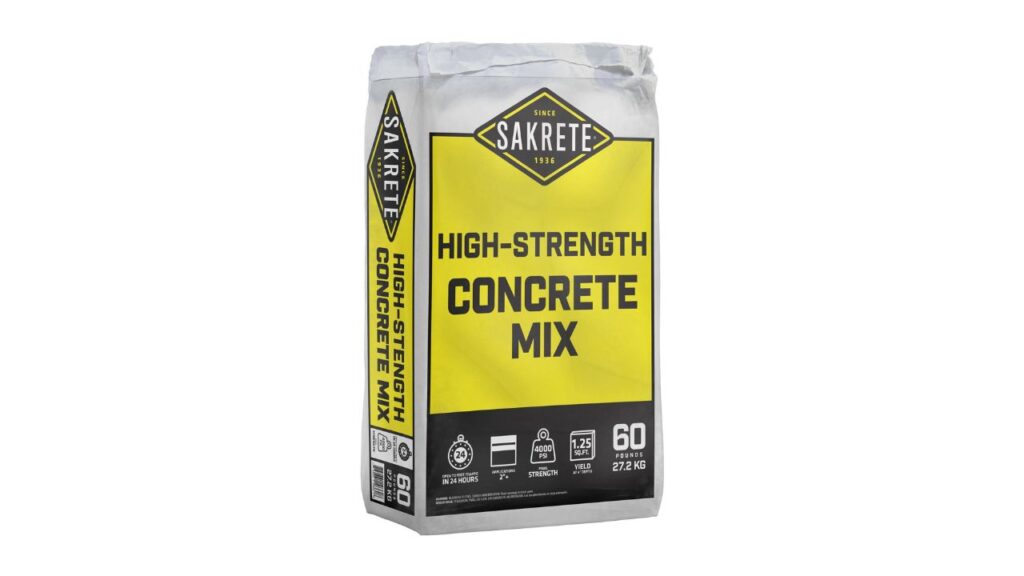
On most job sites, concrete decides how well everything performs.
Sakrete concrete mix is a pre-blended, bagged concrete product made with cement, sand, and aggregate, designed to be mixed just with water.
I have used it across a wide range of residential projects and can confirm that Sakrete can be used confidently for both DIY work and professional applications when consistency matters.
What stands out to me is how sakrete concrete mix supports the overall foundation of a project.
Because the blend is controlled and reliable, it cures evenly and can last longer.
That stability plays a big role in how slabs, footings, and steps hold up over time.
It also affects the surface finishes and alignment. A solid mix reduces the risk of cracks, weak spots, and uneven settling later on.
I usually suggest Sakrete when the project calls for convenience without sacrificing performance.
It is a smart option for fence posts, small slabs, patios, steps, and repair work.
When you want predictable results, faster setup, and less on-site guesswork then Sakrete is he right choice.
Quikrete Concrete Explained: Uses, Strength, and Performance
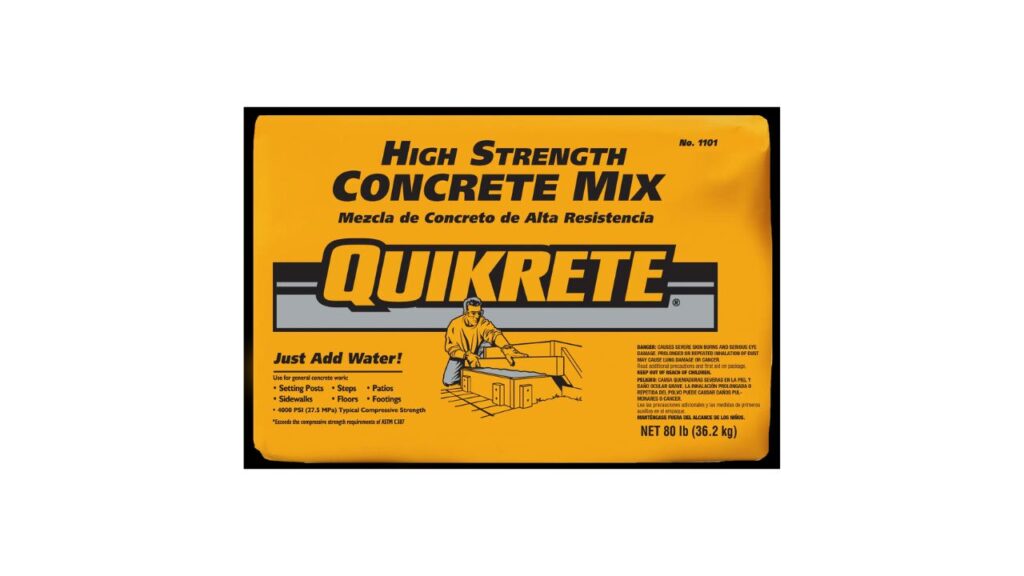
Some materials earn their place by making demanding projects easier to manage.
Quikrete concrete mix is one of those products, especially when schedules are tight and consistency matters.
I have relied on this for both planned pours and last-minute fixes, and its simple ‘add water to mixture’ setup keeps the work moving.
Availability of quikrete home depot locations also makes it a practical choice when materials are needed quickly.
From a foundation standpoint, QUIKRETE Concrete Mix delivers dependable strength and steady curing.
It bonds well and performs reliably in footings, slabs, and steps, which directly affects how long those surfaces last.
Before larger pours, I often use the quikrete calculator to plan quantities accurately, helping avoid delays and material waste on site.
I tend to suggest Quikrete when the project demands flexibility.
Its fast setting variant is ideal for posts and quick repairs, while the standard mixes offer more working time for patios, sidewalks, and structural pours.
When ease of use, speed, and proven performance matter, Quikrete remains a dependable option.
Can You Mix Quikrete And Sakrete Together?
On renovation sites, it is tempting to use whatever bags of concrete are left over to finish a pour.
I have seen many homeowners ask whether combining different concrete mixes will save time or money.
While it may work as a shortcut, it’s not quite effective in the long run, you will have to face some problems.
So, the short answer is no – you should not mix Sakrete and Quikrete together, especially when the variants you use would be different.
Even though both are Portland cement-based, their formulas are not the same.
Each brand uses its own additives, accelerators, and aggregate ratios.
When these are combined, curing can become uneven. This leads to weak spots, surface cracks, or sections that stay soft longer than they should.
This risk increases when fast-setting mixes are involved, because mixing a fast-setting product with a standard or high-strength mix often creates cold joints and inconsistent strength across the slab.
In my experience, concrete performs best when it is predictable.
If a project needs a quick setting, use a fast-setting mix from one particular brand only.
Similarly, if a project requires strength and durability, stick with the standard or high-strength option.
Choosing the right product upfront and sticking with it will deliver better results than trying to blend different mixes together with separate PSIs (pounds per square inch).
Sakrete vs Quikrete: Side-by-Side Concrete Mix Comparison
After working with both brands across different types of projects, it becomes clear that these two mixes, while being similar, are not interchangeable.
Sakrete and Quikrete are both reliable concrete options, but they are designed with different priorities in mind.
Their formulas, setting times, and ideal use cases vary, which directly affects how they perform on site.
In practice, one may be better suited for installations and time-sensitive repairs, while the other offers more control for finishing and structural pours.
These differences matter because they affect the strength, workability, and long-term durability of the concrete mix.
Now, we will break down the key factors that separate these two mixes in detail.
Best Use Cases for Sakrete vs Quikrete Concrete Mix
On residential projects, how a concrete mix is used often matters more than its label.
Sakrete is versatile enough to handle both structural work and everyday repairs, which is why I reach for it often.
It performs well in slabs, patios, sidewalks, and driveways, and it is also reliable for footings, steps, curbs, and foundation-related work.
Quikrete proves useful when projects vary in size and urgency, across many residential jobs.
I have used it for everyday concrete work that needs a clean, durable finish.
Its pre-blended formula keeps things simple, especially on smaller jobs where mixing from scratch would slow down the progress.
Personal Recommendation: From my experience, the choice in sakrete vs quikrete concrete mix depends on the job.
I lean toward Sakrete for the controlled pours and finishes, while Quikrete works better when speed, availability, and quick turnaround are priorities.
Sakrete vs Quikrete Cost
Budget decisions often shape material choices just as much as performance.
With Quikrete, material costs can stay relatively low for small or thin applications – roughly $0.15 – $0.30 per sq ft for thin slabs, especially DIY projects.
Thicker slabs and high-strength materials increase the price, rounding off to $3.50 – $10 per sq ft, and labor quickly becomes the biggest expense.
Quikrete works well when you want flexibility across project sizes and are comfortable adjusting costs based on depth and mix depth.
Sakrete, on the other hand, tends to price slightly higher, around $0.80 – $1.20 per sq ft for materials, depending on bag size and formula.
Larger bags usually offer better value, while high-strength options cost more upfront, roughly between $5 – $10.
Personal Recommendation: In my opinion, Sakrete vs quikrete cost comes down to scale and control.
For smaller, planned pours, where consistency matters, Sakrete feels worth the price.
For variable jobs or tight budgets, Quikrete offers more room to adjust without overspending.
Which Concrete Mix Lasts Longer?
Material performance does not end once the pour is complete.
With Quikrete, durability depends heavily on storage.
In dry, cool conditions and sealed properly, it can remain usable for weeks.
In humid environments, moisture quickly activates the mix, causing clumping and reduced strength, especially for structural work.
Sakrete shows slightly better tolerance when stored correctly but it’s not immune to moisture.
Airtight containers and stable temperatures help preserve its consistency.
Once exposed to humidity, strength, and reliability drop fast, which can affect long-term performance.
Personal Recommendation: I believe that durability comes down to discipline, not brand.
I recommend buying only what you need and storing bags carefully.
When handled right, both deliver lasting results, but Sakrete feels slightly more tolerable in controlled storage conditions.
Application Differences
Getting clean results often depends on how easily a mix can be applied on site.
With Quikrete, the application is straightforward, especially for posts and quick repairs.
Fast-setting potions can be poured dry into holes and activated with water, while standard mixes are blended to a workable consistency for slabs and surface work.
This flexibility helps when time is limited.
Sakrete follows a more methodical approach during application.
Surface prep, careful mixing, and controlled placement play a bigger role, which I find useful for repairs and finishes that need precision.
Its mixes spread evenly and respond well to proper curing, making them easier to manage for detailed work.
Personal Recommendation: From a practical standpoint, my preference shifts based on finish expectation.
When sakrete vs quikrte color and surface consistency matter, I lean toward Sakrete.
For speed and simple application, Quikrete remains the more reliable option.
Sakrete vs Quikrete for Moisture-Prone Areas
Moisture performance becomes obvious only after the concrete has cured and been tested under real conditions.
With Quikrete, moisture resistance is solid once the mix has set properly.
The key is controlled mixing and curing – too much water or early exposure can weaken the slab, but when cured correctly, it holds up well against everyday moisture.
Sakrete, on the contrary, takes a more layered approach to moisture control.
Standard mixes rely on proper curing, but specialised options are designed specifically to block or manage water intrusion.
Products like hydraulic formulas add an extra level of protection in moisture-prone areas.
Personally, I match the product to the environment.
For general outdoor use, both perform well. But, in basements or damp spaces, Sakrete’s targeted moisture solutions give it a clear edge.
Quikrete vs Sakrete for fence posts
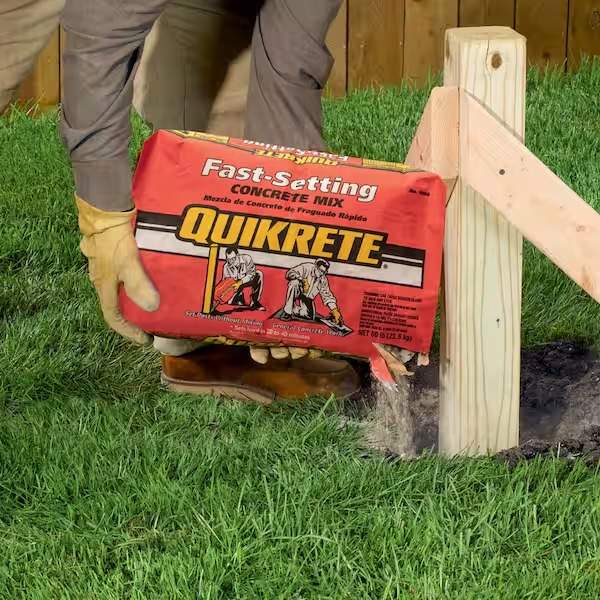
Fence posts may seem simple, but the concrete choice affects how stable they remain over time.
I have installed posts in client homes using both products, and each handles the job well when used correctly.
Quikrete is often favoured for its smoother texture and fast setting options, which make it easier to work with on smaller or time-sensitive installs.
It is especially convenient when you want posts set quickly without extensive mixing.
Sakrete, on the other hand, feels more traditional in composition.
The mix can contain larger aggregate and a slightly heavier feel, which some users prefer for long-term strength.
It works well for larger fence lines, where cost matters and mixing time is less of a concern.
Availability can also influence the choice, with Quikrete commonly found at Home Depot and Sakrete at Lowe’s.
My recommendation depends on pace and scale. If you want quick installs that can be done over the weekend, Quikrete saves time.
For longer runs where strength and budget matter more, Sakrete remains a reliable choice.
Sakrete vs Quikrete: Side-by-Side Concrete Mix Comparison
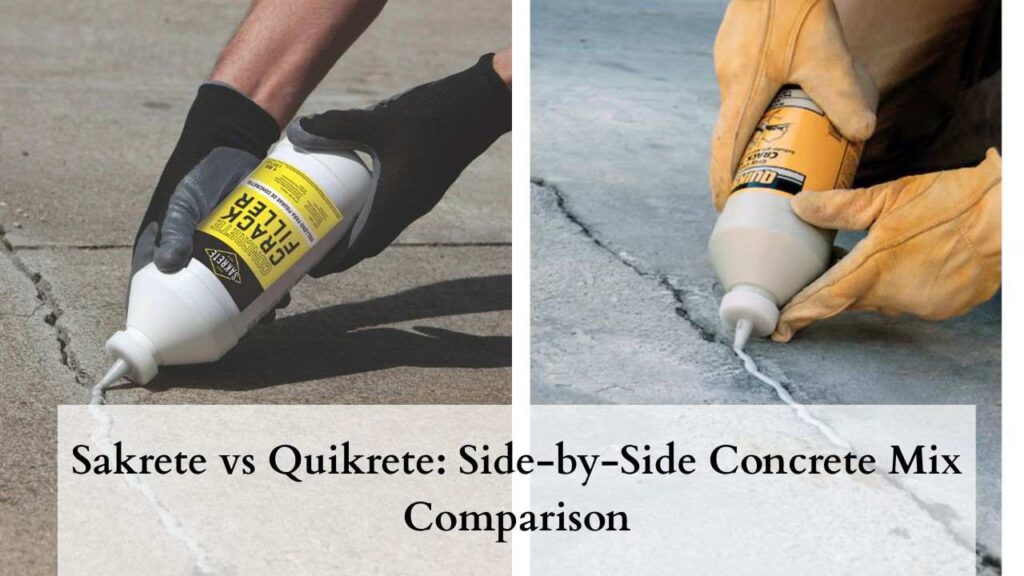
Walking down the concrete aisle in any hardware store, it becomes clear that both brands offer far more than a single mix.
Sakrete and Quikrete each provide a wide range of variants designed for specific needs – from fast-setting options to high-strength mixes and repair-focused products.
I have worked with several of these variants over the years, and the right option often matters more than the brand name itself.
Some mixes are built for speed, others for depth, durability, or surface repair.
Understanding these differences helps avoid mistakes and wasted material.
Now, we will compare Sakrete and Quikrete variants side by side to see how they perform in real project scenarios.
Sakrete vs Quikrete Hydraulic Cement
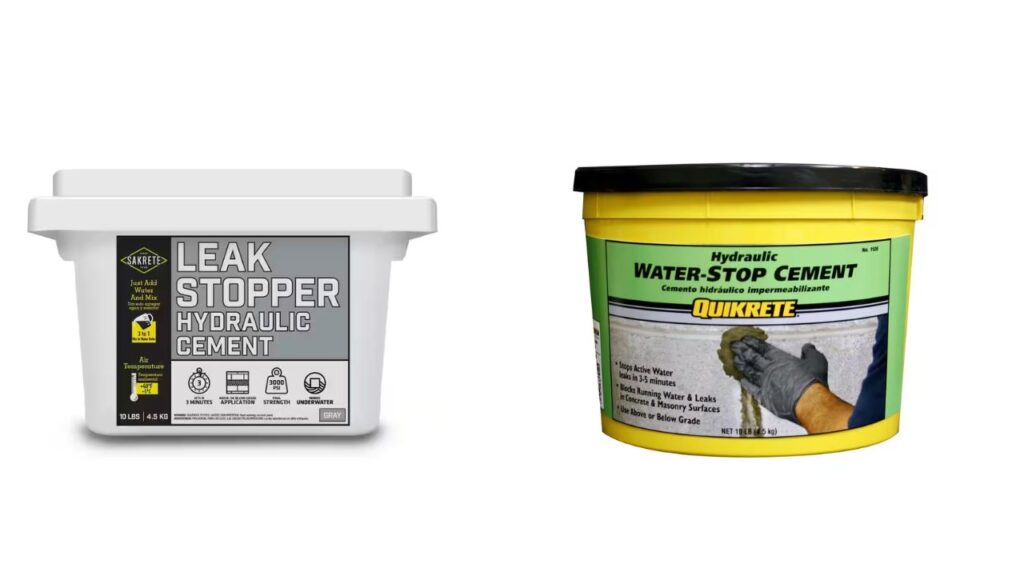
Stopping active leaks leaves very little room for error.
Quikrete hydraulic cement sets within minutes and is commonly used to plug water seepage in basements, foundations, and masonry joints.
I find its finer texture easier to pack into tight cracks, especially when working against running water under pressure.
Sakrete hydraulic cement performs the same core function but can feel slightly coarser during application.
It still expands as it sets, which helps lock it in place and block moisture effectively.
In areas where access is limited and leaks are aggressive, proper placement matters more than mix elements.
My personal choice comes down to feel and access.
Quikrete works better for quick placements and tight cracks, while Sakrete is just as reliable when applied carefully and cured as directed, especially when it is the more accessible option.
Sakrete vs Quikrete Crack Filler
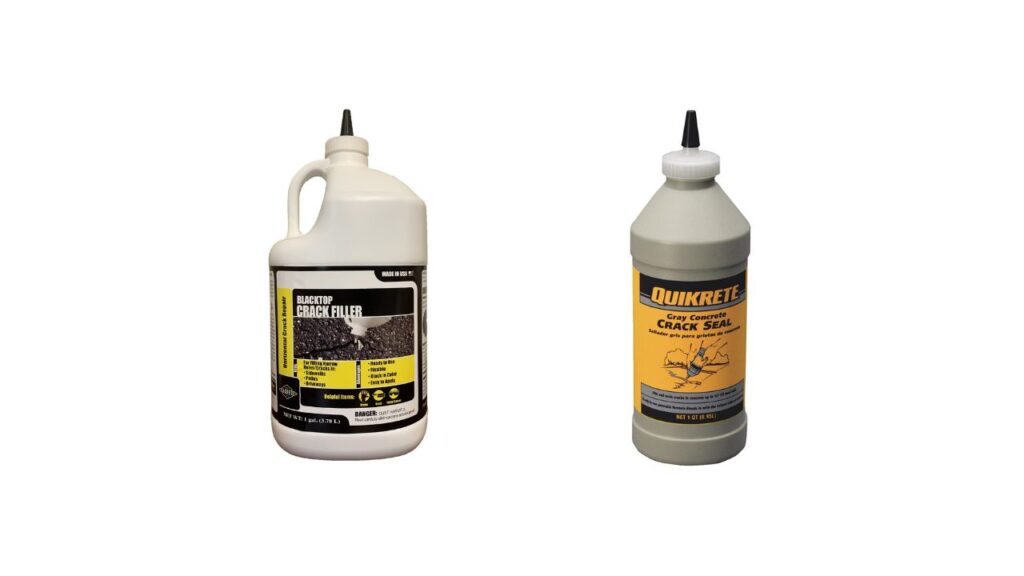
Hairline cracks are easy to ignore until they start spreading across a slab. With Quikrete crack filler, repairs feel easy.
The self-leveling consistency works well for driveways and sidewalks, flowing into narrow gaps and setting quickly.
It is especially useful when you want a smoother finish without extra tooling.
Sakrete crack filler takes a slightly different approach in texture.
It can feel thicker and less fluid, but it still handles common surface cracks well when the area is prepped properly.
Coverage matters more than the appearance here, and it performs reliably for everyday fixes.
Looking at real world results, my choice depends on finishing expectations.
For visible areas, Quikrete delivers a cleaner look. For functional repairs where ease and coverage matter more, Sakrete is a solid, no-fuss option.
Sakrete vs Quikrete Sand
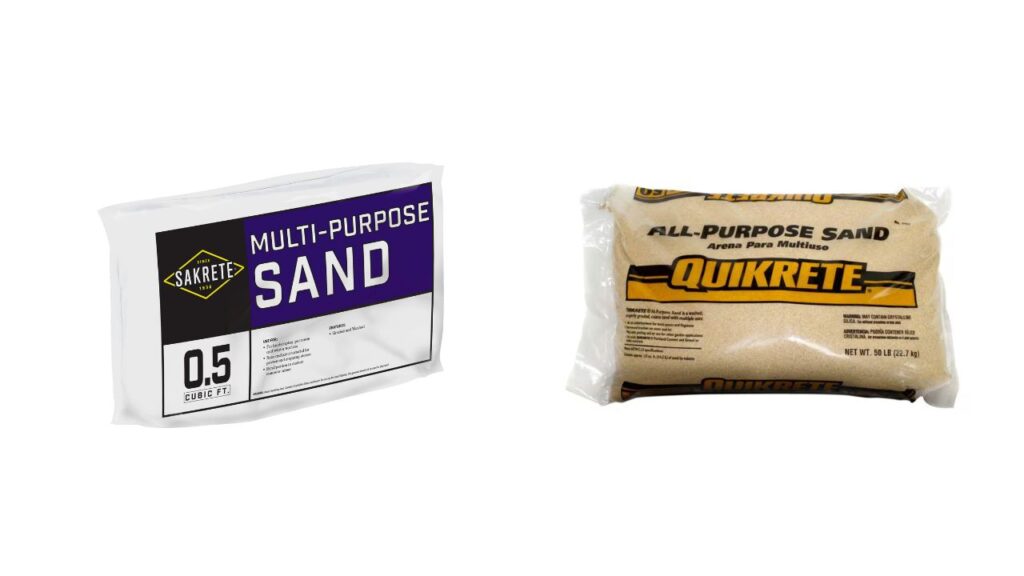
Not every concrete job needs stone and bulk. Sometimes, sand-based mixes are the smarter choice.
Quikrete sand mixes are commonly used for topping and resurfacing worn concrete, especially when working two inches.
They spread easily and are practical for quick fixes where speed and availability matter more than finesse.
Sakrete sand mixes lean toward control and density.
I often prefer them for thinner applications like shower pans or detailed patching, where a tighter texture helps achieve a smoother, more even finish.
Speaking from experience, my decision is usually driven by concern.
Quikrete works when I need speed and access.
Sakrete earns my vote for refined work where texture, consistency, quality, and finish take priority.
Sakrete vs Quikrete Play Sand
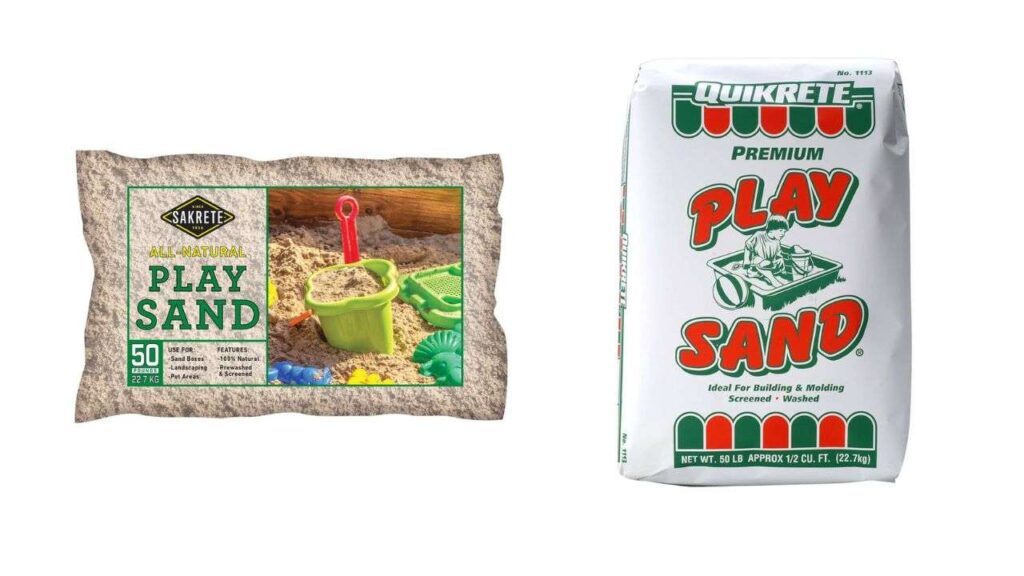
When the project shifts from concrete to comfort, texture starts to matter more.
Quikrete play sand is usually finer and more uniform – which makes it easier to spread, mold and evenly settle.
I have found it works well for sandboxes and temporary uses where smoothness and consistency are important.
Sakrete play sand serves the same purpose but can feel slightly coarser depending on the batch.
It is still washed and screened, though I often recommend wetting or lightly sifting it first to improve usability, especially for play areas or indoor use.
Looking at sakrete vs quikrete play sand for sand bags, I lean a little toward Quikrete for cleaner fill and smoother packing.
Sakrete works just as fine, but Quikrete feels mofe predictable and easier to manage.
Sakrete vs Quikrete Fast Setting
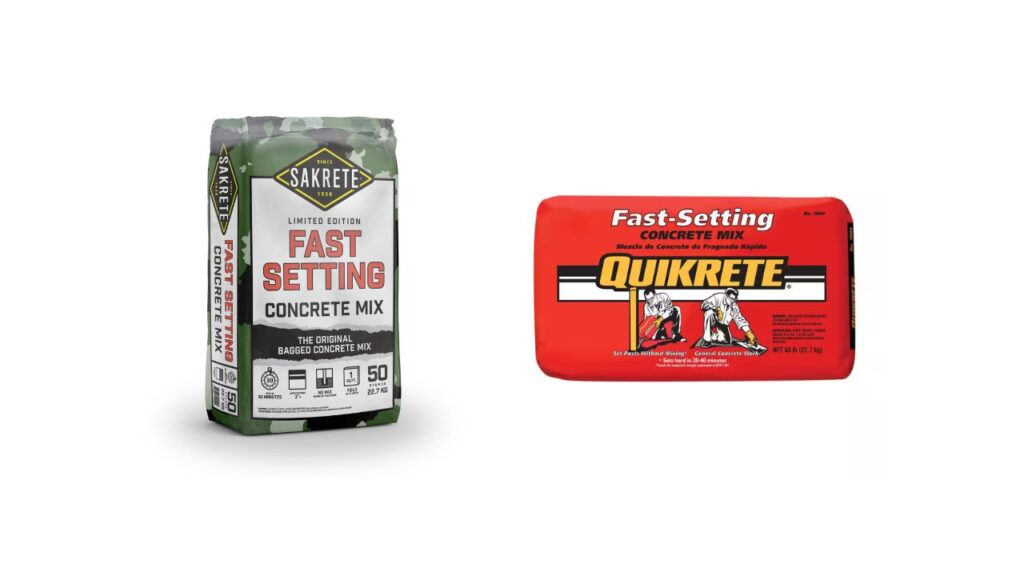
Deadlines change how concrete gets chosen. Quikrete fast setting options are built for speed, setting within 20 – 40 minutes and reaching strengths as high as 7,000 PSI.
I rely on it for posts, pads, and quick installs where movement needs to stop fast and waiting is not an option.
Sakrete fast setting concrete mix vs quikrete feels more measured in use.
Sakrete typically sets in 30 minutes and reaches around 4,000 PSI which is still more than adequate for posts, stairs, curbs and small slabs.
It offers better control when alignment matters, especially alongside sakrete vs quikrete mortar mix decisions on masonry jobs.
My pick always depends on urgency.
For maximum speed and higher strength, Quikrete wins.
When balance, control, and predictable handling matter more, Sakrete fast setting concrete mix delivers steadier results without the rush.
Sakrete vs Quikrete Reviews and Real-World Feedback
Once you move past the product labels, new users are able to understand why reviews are important.
Any brand-backed feedback for Sakrete and Quikrete usually highlights performance, claims, strength and intended use.
User reviews fill the gaps that website information or even the hardware reps cant tell.
People talk about how the concrete mix felt out of the bag, performance during application, and whether the finish aged well.
You also see frustrations around clumping, setting being incomplete, or storage issues.
Taking both perspectives together gives a clearer sense of what to expect before choosing a mix.
After going through multiple sakrete vs quikrete reddit threads, I have noticed how openly users discuss the real concrete issues like mixing, consistency, setting time and how each brand actually performs once the slab cures.
A very kind user pointed out the difference between Quikrete and Quikrete Fast Setting, “FAST SETTING QUIKRETE will not give you anytime to work the mixture around once it touches water.
It will get kind of hard to move in 10-15 mins and get completely hard in 20 mins. NORMAL QUIKRETE will give you more time to work with the mixture and will take a day to set and become completely hard. The final strength of both the mixes is same and takes about 28 days to achieve that”
That is the most accurate description of the Quikrete variants I have ever come across.
I have told this to almost all of my clients who have asked which Quikrete variant to use.
Another user pointed out their mistake regarding using Quikrete, “I have to confess for a long time I did not follow the mixing instructions when it came to amounts added to Quikrete. I think I added what the recommended amount was and decided it was lacking water. And it wasn’t a long time ago that one day, I was intent on having a good, strong pour. I ended up mixing 2- 80lb. bags of Quikrete with six quarts of water for each wheelbarrow load. It took 10 minutes to mix both bags thoroughly, but I could see when it was truly mixed thoroughly. This wasn’t the case many times using the electric mixer.”
I thoroughly agree with this user and tell all my clients to please read the instructions on the bags carefully before mixing!
This is a very crucial step and if you mess this up, the entire thing will go to waste.
Sakrete vs Quikrete: Which Concrete Mix Has the Edge?
Sakrete and Quikrete are both pre-blended concrete options designed for durability, ease of use, and consistent results.
They share similar base components, yet differ in texture, setting time, and available formulas, which affects how they behave on site.
From everyday repairs to structural pours each mix responds differently to water, working time, and finishing.
Those small differences often shape the final outcome more than expected.
To understand where each one shines or falls short, we will now break down the specific Pros and Cons of each concrete mix in detail.
Pros
Sakrete: This brand leans more toward controlled performance and consistency.
Its mixes are easy to handle, set quickly, and deliver dependable strength, especially in polymer modified options like Sakrete Pro Mix.
That makes Sakret appealing for repairs or jobs where clean application and predictable results matter.
Quikrete: For this brand, the biggest advantage is how adaptable the mixes across project sizes.
Many formulas offer fast walk on strong PSI ratings, and fiber reimbursements that cut down cracking.
For DIY work and small slabs that balance speed, strength and easy finish, it is hard to ignore.
Cons
Sakrete: Sakrete’s downsides tend to be more about control.
Some products shrink or crack if the mix is even slightly off, and water measurements need care.
Packaging issues come up occasionally, and certain mixes use larger aggregate that can limit specialised applications.
Quikrete: With this brand, most drawbacks, show up when conditions or handling are off.
Batch consistency can vary, and fast setting formulas leave little room for adjustment.
The mix is also sensitive to water ratios, and silica dust.
This means safety gear is not optional, especially on larger pours.
Sakrete vs Quikrete: Which is the strongest concrete mix?
Wehn strength is the main concern, Quikrete often gets attention for its higher-end numbers.
Its Fast Setting and high-performance mixes can reach upto 7,000 PSI.
The texture is usually finer, which helps with mixing and finishing, especially for DIY work. That makes a difference for posts, pads, or repairs where early load matters.
You will find Quikrete easily at Home Depot, though it is often priced slightly higher.
The trade-off is less working time and the need to be precise with water.
Sakrete, on the other hand, approaches strength with more consistency than speed.
Many of its standrad mixes sit around 4,000 PSI, while options like Sakrete Maximiser push closer to 5,500 PSI.
The mix tends to include larger aggregate, so placement takes a bit more care to fully cover the stones.
Sakrete is commonly stocked at Lowe’s and is often a tad bit cheaper.
It suits projects where solid strength matters, but early PSI is not critical.
In the end, it all depends on what kind of home project you have that will suit Sakrete or Quikrete.
Conclusion
This comparison guide began with one simple goal: breaking down sakrete vs quikrete in a way that feels practical.
Instead of focusing on brand claims, we discussed how these mixes perform in everyday projects, from small repairs to heavier structural work.
Along the way, we covered fast-setting options, strength differences, textures, ease of use, and where each brand tends to shine or fall short.
Reviews, real-user feedback, and common job scenarios helped highlight why one mix may feel easier to work with, while another may deliver faster strength or better consistency.
By the end, the choice between sakrete vs quikrete comes down to what your project needs the most – speed, strength, finish or flexibility.
Both brands are reliable when used correctly.
Knowing and understanding their differences simply help you pick with more confidence, fewes surprises, and better results overall.
FAQs on Sakrete vs Quikrete
Is Sakrete as strong as regular concrete?
How long does it take for Quikrete concrete to dry?
How long does Sakrete last?
Does Sakrete need to be sealed?